Your Waistline Changed First
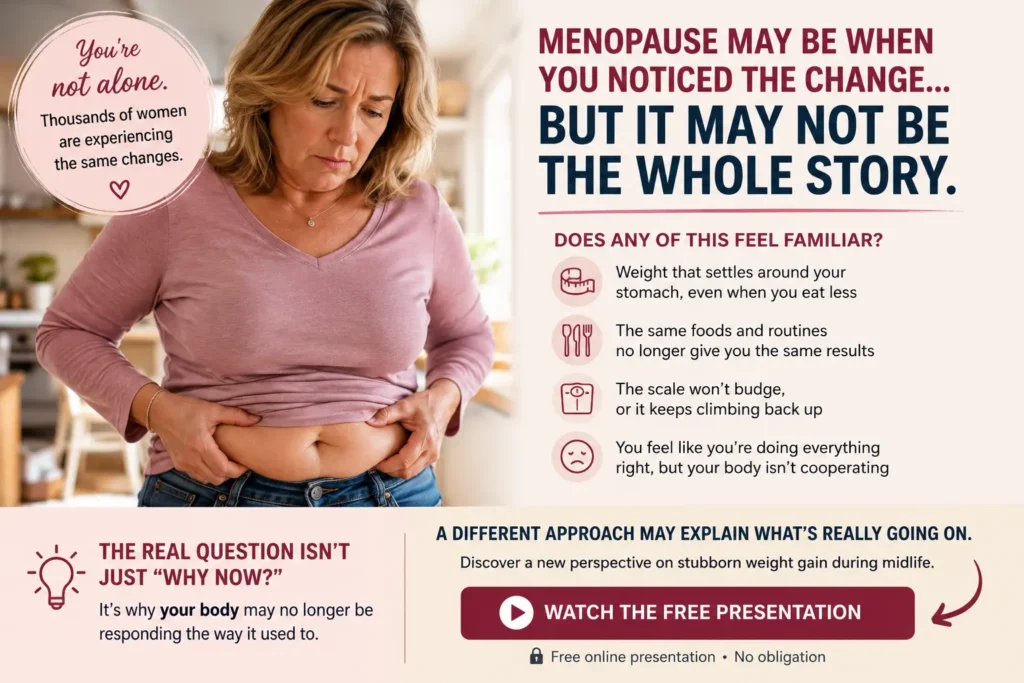
Weight that once seemed evenly distributed now appears to settle more stubbornly around your stomach and waist.


Menopause weight gain is common during midlife. Changes involving hormones, muscle mass, metabolism, sleep and daily habits can all influence how the body stores and uses energy.
As a result, many women notice that losing weight becomes more difficult than it was in their 20s or 30s, even when they have not dramatically changed the way they eat or exercise.
This does not mean weight loss is impossible. It simply means the body may respond differently than it did in earlier years, and the same routine may no longer produce the same results.
Menopause weight gain is often influenced by several body changes happening at the same time—not by a lack of effort alone.
Many women feel confused when the scale begins moving in the wrong direction, their clothes become tighter and habits that once worked no longer seem to make the same difference.
The hardest part is often not just the weight gain. It is the feeling that your own body is no longer responding the way it used to.

It is easy to blame every frustrating change on menopause alone. But many women eventually realize that the real question is not simply “Why is this happening now?”
The more useful question may be: “Why is my body no longer responding to the same things that used to work?”
Weight that once seemed evenly distributed now appears to settle more stubbornly around your stomach and waist.
You cut portions, skip desserts or try to be more careful—yet the scale barely moves or quickly climbs back up.
Walking more, choosing lighter meals or repeating an old diet no longer creates the noticeable difference it once did.
The effort is still there. What has changed is the way your body seems to respond to that effort.
Menopause can coincide with meaningful changes in a woman’s body. But focusing only on the word “menopause” can sometimes leave women with an incomplete explanation—and no clearer idea of what to do next.
A broader perspective looks at what may have changed in the way the body handles energy, appetite, stored fat and everyday habits during midlife.
That is what many women tell themselves at first.
They become stricter with food. They promise to exercise harder. They restart another plan on Monday. And when the results still fail to match the effort, they assume they must be doing something wrong.
But what if the problem is not that you suddenly lost your willpower? What if your body is simply responding differently—and your strategy has not changed with it?
A short online presentation is helping women explore a broader explanation for why weight can become so stubborn during midlife—even when they are genuinely trying.
The presentation is not specifically about menopause. Instead, it focuses on the larger weight-loss problem many women begin noticing around the same stage of life:
It may help you stop viewing your struggle as a personal failure and start asking a more productive question: What changed inside the process?
You do not need to make any decision now.
Free online presentation • Watch from the beginning for the complete explanation
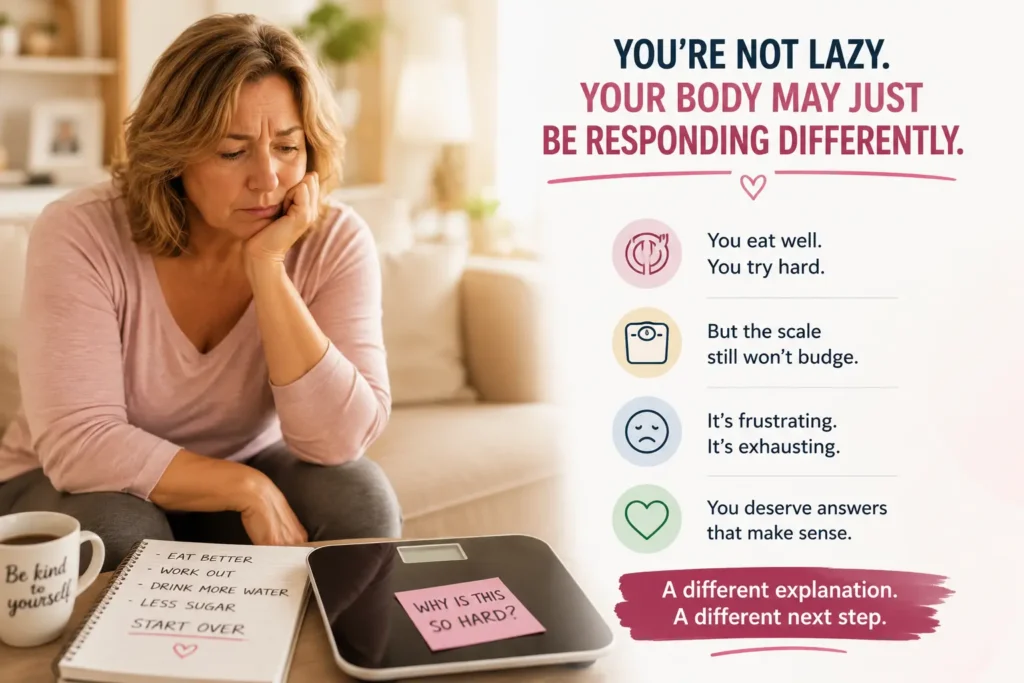
Most women do not suddenly stop caring about their health during midlife. In fact, many begin trying harder than ever.
They become more careful with food, promise themselves they will walk every day and repeatedly start over—only to watch the same stubborn weight remain around their stomach and waist.
Smaller portions, fewer treats and another promise to be “good” all week.
A few days pass, then a few weeks—but the progress feels painfully slow or disappears almost immediately.
You wonder whether you lack discipline, whether you ate too much or whether this is simply how your body will be from now on.
“I’m already eating less than I used to. How much more am I supposed to give up before my body finally responds?”
Outfits that once made you feel confident stay hidden in the back of the closet.
Every meal begins to feel like a test you might somehow fail.
The frustration follows you into photographs, social plans and quiet moments alone.
When a strategy repeatedly fails, the natural reaction is to use more force: eat less, exercise harder and become even stricter.
But if your body is responding differently than it did years ago, repeating the same approach more aggressively may only create more frustration.
Many women spend years believing their struggle is only about calories, motivation or age.
But when they begin looking at the broader process behind stubborn weight, they often realize there may be more to understand before choosing another diet.
And that broader perspective is exactly what the short presentation ahead begins to explore.
See the Broader Explanation →Free online presentation • No obligation
If two women eat similar meals, stay equally active and make the same effort, why does one seem to lose weight while the other continues to struggle?
That question suggests there may be more involved than calories, discipline or motivation alone.
The goal may not be to keep doing more. It may be to understand why your body is no longer responding the way it once did.
A short presentation explores a broader perspective on stubborn weight and why familiar approaches may stop delivering familiar results.
Discover What May Have Changed →Free online presentation • Start from the beginning

Weight management is influenced by more than a single habit or one moment in life. Researchers continue to examine how changes involving muscle mass, sleep, appetite, daily movement and energy use may shape the way the body responds during midlife.
There is no single explanation that applies to every woman. But the growing research around midlife weight helps explain why a plan that worked years ago may not produce the same results today.
Muscle supports everyday energy use. Gradual changes in muscle mass may influence how the body uses energy over time.
Poor sleep and ongoing stress can affect appetite, energy and the ability to maintain consistent healthy routines.
Small changes in how much a person moves throughout the day may add up, even when formal exercise habits appear unchanged.
The body can adjust to repeated dieting and changes in food intake, which may help explain why progress sometimes slows.
For many women, menopause is the stage when stubborn weight becomes more noticeable. Yet the most useful next step may be to look beyond the label and understand the wider process affecting the body’s response.
The free presentation ahead explores the broader weight-loss struggle many women experience during midlife. It is not a presentation about menopause alone. It focuses on why familiar strategies may stop producing familiar results—and what a different perspective may reveal.
Free online presentation • Start from the beginning

Weight changes during menopause can feel confusing—especially when the habits that once worked no longer seem to produce the same results. These answers can help you see the struggle from a broader perspective.
Menopause weight gain may involve several overlapping changes, rather than one single cause. Hormonal shifts may influence where fat is stored, while aging can also affect muscle mass, activity levels, sleep, appetite and the amount of energy the body uses.
This is why simply telling a woman to “eat less and move more” may not fully address what she is experiencing.
Many women find that losing weight becomes more difficult during and after midlife. The same meals, walking routine or diet that once produced visible progress may begin producing much smaller changes.
That does not necessarily mean you have become lazy or undisciplined. It may mean your body is responding differently than it did years ago.
Eating the same way does not always guarantee the same outcome because your body may no longer use energy in exactly the same way. Changes in muscle mass, daily movement, sleep, stress and metabolism may all influence the result.
Many women notice that their body shape changes during midlife, with more weight appearing around the abdomen even when their total weight has not changed dramatically.
Hormonal changes may influence fat distribution, but aging, reduced muscle mass, sleep, stress and lifestyle changes can also contribute to the larger picture.
The body’s energy needs can gradually change with age. Loss of muscle mass may reduce the amount of energy used at rest, while changes in movement, sleep and eating patterns may further affect the process.
Menopause may be when these changes become noticeable, but it may not be the only factor involved.
A diet that worked years ago may no longer produce the same result because your daily energy needs, body composition and response to repeated dieting may have changed.
Continually cutting more food without understanding that broader process can leave you hungry, tired and frustrated—while the scale barely moves.
Struggling with weight is not proof that you lack willpower. Many women are already making a serious effort—watching what they eat, walking, avoiding certain foods and repeatedly starting over.
When a familiar approach stops working, the answer may not be to blame yourself. It may be time to examine the problem from a different perspective.
Poor sleep can affect energy, appetite, food choices and the motivation to stay active. Hot flashes, stress and interrupted sleep may make healthy routines more difficult to maintain.
Sleep is only one part of the picture, but it may help explain why weight management becomes more challenging during this stage of life.
Food choices and physical activity remain important, but simply doing more and eating less may not be the complete answer for every woman.
If you have already tried that approach repeatedly without lasting progress, learning why your body may be responding differently could be a more useful next step than beginning another restrictive plan.
First, recognize that your frustration is understandable. If you have tried dieting, cutting portions, avoiding favorite foods or exercising more without seeing the progress you expected, repeating the same strategy may only create more disappointment.
A better next step may be to understand the broader process that can make stubborn weight feel so resistant during midlife.
The free presentation explores why familiar weight-loss strategies may stop producing familiar results—and introduces a different way to look at stubborn weight.
Discover What May Be Holding You Back → Free online presentation • Start from the beginningYou already know what it feels like to try harder. The next step is to understand why the same effort may no longer create the same result.
For additional educational information about menopause, aging and weight changes, explore these independent government health resources.
Explore other guides that may help you better understand stubborn weight and the changes many women notice during midlife.
Understand the broader factors that may influence healthy and sustainable weight management.
Read the guide → MIDLIFE WEIGHTWhy the body may begin responding differently—and why old strategies may no longer feel as effective.
Read the guide → COMMON FRUSTRATIONExplore why effort does not always translate into progress and what may be missing from the usual advice.
Read the guide →