You are genuinely trying
- Making healthier food choices
- Walking or exercising more often
- Watching portions and cutting back
- Trying to stay consistent week after week


Your face may look slimmer. Your clothes may fit differently. The number on the scale may even be moving in the right direction.
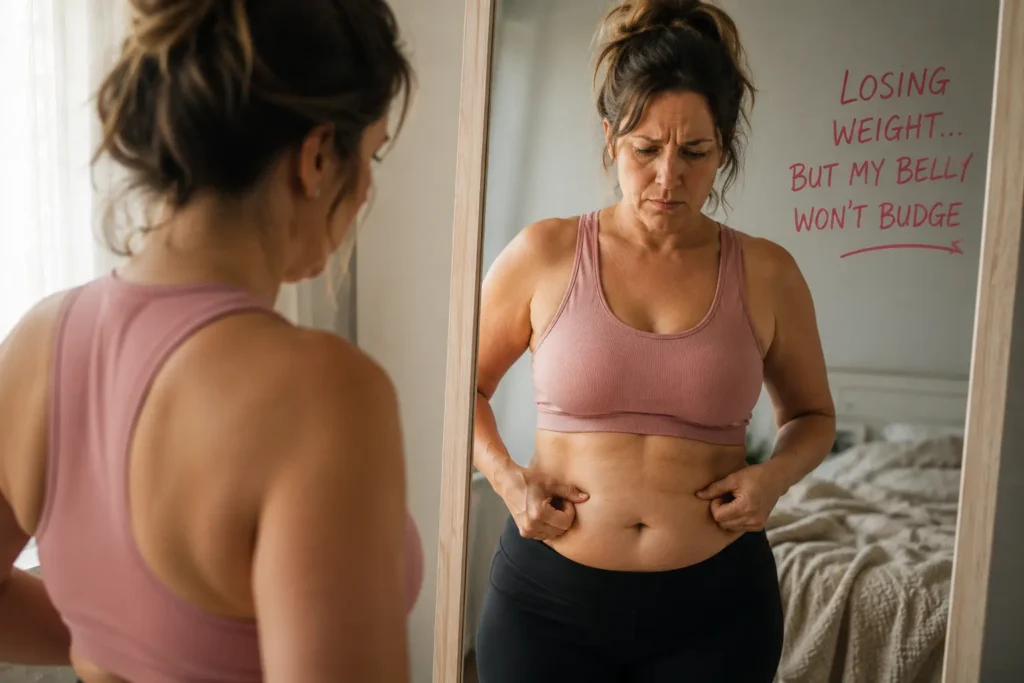
Yet every time you look in the mirror, the area you wanted to change the most still seems almost untouched.
Belly fat may appear slower to change because fat loss does not happen evenly across the body. Age, sleep, stress, hormonal changes, muscle loss, daily habits and individual fat-storage patterns may all influence where visible changes appear first.
But knowing that does not make the frustration feel any easier.The lower stomach still feels soft, heavy or difficult to hide. Waistbands still press into the same place.
And the mirror keeps raising the same painful question:
“Why is this the one area that will not respond?”I am not expecting perfection. I just want my belly to finally reflect all the effort I have been making.
You have lost weight from your face, arms or legs—but not your stomach.
Your clothes fit better everywhere except around your waist.
You exercise consistently, but your belly barely looks different.
You eat less than before yet still feel uncomfortable in fitted clothes.
What worked years ago no longer seems to create the same result.
You are starting to wonder whether trying harder will change anything.
It can change how you stand in front of the mirror, which photos you keep, what you wear to social events and how comfortable you feel being seen.
You may begin hiding behind loose tops, pulling fabric away from your stomach or avoiding outfits you once enjoyed.
Not because you have stopped caring—but because caring so much has become exhausting.So you cut back again. Add another workout. Promise yourself that this time you will be even more disciplined.
But when the same area continues resisting visible change, the problem begins feeling personal—as though your body is ignoring everything you do.
The free presentation below explores a different perspective on why stubborn belly fat may remain difficult to change even when you are eating better, moving more and genuinely trying.
Free presentation • Discover a different perspective before trying another restrictive plan
This is usually the moment when frustration turns into self-doubt.
You know you are making better choices. But the one area you notice first in the mirror still refuses to reflect all that effort.
How much harder am I supposed to try before my stomach finally changes?
You remove another food, reduce another portion or begin feeling guilty about meals you once enjoyed.
You walk longer, add another workout or tell yourself that being tired is simply the price of finally losing your belly.
You stand in front of the mirror, pull your shirt tighter and search for proof that the effort is finally working.
When your stomach still looks familiar, it becomes harder not to believe that you are failing.
Your face may look thinner. Your arms may feel smaller. Some clothes may fit better.
But if the waistband still feels tight and your lower belly still folds over it, those other changes may feel almost invisible.
You change outfits several times because everything seems to draw attention to your stomach.
You automatically place a bag, pillow or folded arms across your belly in photos.
You avoid fitted clothes even when you genuinely like how they look on other women.
You compare your current body with the version of yourself that seemed to lose weight more easily years ago.
There is only so long someone can keep eating less, exercising more and blaming herself before wondering whether the advice she has been following is missing something important.
Your frustration may not be proof that you need more willpower.The free presentation below explores a different perspective on why stubborn belly fat can remain difficult to change—even when you are eating better, walking more and doing what you were told should work.
Free presentation • Discover a different perspective before blaming yourself again

You have already tried eating less, moving more, cutting foods and becoming stricter with yourself.
If more effort were the only answer, your belly should have changed by now.
Maybe the problem is not that I have not tried hard enough. Maybe I have never been shown what I was actually missing.
You reduced what was on your plate and hoped your waistline would finally begin reflecting the sacrifice.
Bread, sugar, snacks and entire food groups may have become things you feared instead of enjoyed.
You pushed through tiredness because you believed more effort had to create more visible change.
Every disappointment became another Monday, another plan and another promise to be even stricter.
When your face, arms or legs begin changing but your stomach still appears resistant, repeating the same approach more aggressively may only create more frustration.
The missing piece may not be another restriction. It may be a different way of understanding the pattern.
Keep adding rules, removing foods and hoping that more pressure will finally force your belly to respond.
Explore why stubborn belly fat may remain difficult to change even when your effort and consistency are real.
The free presentation below explores a different perspective on stubborn belly fat and why many women feel trapped in the same cycle despite eating better, moving more and doing everything they were told.
See What Your Current Approach May Be Missing →Free presentation • Watch before beginning another restrictive plan

When your effort is real but your stomach still looks the same, it is natural to wonder whether you are doing something wrong—or whether the usual advice is overlooking part of the picture.
Weight loss does not always appear evenly across the body. Your face, arms or legs may look smaller before you notice a meaningful difference around your waist.
This can make genuine progress feel disappointing when the area you care about most still looks almost unchanged.
Where the body stores and releases fat can be influenced by age, genetics, body composition, sleep, stress, activity, eating patterns and hormonal changes.
This is why two women following similar plans may notice completely different changes around their waists.
Exercise can support overall fat loss, strength and body composition, but it does not allow you to choose exactly where visible fat disappears first.
You may be gaining fitness and seeing changes elsewhere before your stomach begins reflecting the same progress.
Choosing nutritious foods is valuable, but the overall pattern still matters—including portions, drinks, snacks, consistency, sleep, movement and how sustainable the plan is.
Becoming increasingly restrictive can also make the process feel exhausting without guaranteeing that your belly will be the first area to visibly change.
Many women naturally store more fat around the lower abdomen, hips or thighs. Your individual storage pattern can influence which areas look different first and which appear to resist change for longer.
A stubborn lower belly does not automatically mean that your other progress is not real.
Midlife may bring changes in activity, sleep, muscle mass, appetite and body-fat distribution. Some women begin noticing more weight around the waist even when their habits have not changed dramatically.
This can make strategies that worked years ago feel much less predictable now.
Hormonal changes may influence body composition and where fat is stored, particularly during midlife and the menopausal transition.
However, hormones are only one part of a larger pattern that can include age, genetics, muscle mass, sleep, eating habits and daily activity.
Exercises can strengthen your abdominal muscles, but they do not guarantee that fat will disappear only from your stomach. Visible fat loss generally occurs as part of broader changes in body composition.
That distinction explains why doing more abdominal exercises may not produce the mirror change you expected.
Watch the free presentation exploring why stubborn belly fat may remain difficult to change—even when you are eating better, moving more and genuinely trying.
See What Your Current Approach May Be Missing →Free presentation • Watch before beginning another restrictive plan
These guides explore the frustrations, body changes and unanswered questions many women experience while trying to lose weight.
RECOGNIZED HEALTH REFERENCES
Review recognized public-health resources for additional information about body weight, abdominal fat, lifestyle factors and weight management.
Weight Insight is an independent editorial website and is not affiliated with or endorsed by the organizations listed above.